A note before we begin: Catalysis is my own project. I made the whole thing, from the first sketch to the last screen: the idea, the design, the build, every feature you'll read about below. I use it every morning, and I'm writing about it here because the people who read this magazine are the people I built it for. Take what follows as an invitation from its maker, not a neutral review.
In chemistry, a catalyst is a strange and lovely thing. It enters a reaction that might otherwise take years, or never happen at all, and makes it happen now. It lowers the hill a molecule has to climb. And when the reaction is over, the catalyst is still there, unchanged and unspent, ready to do it again.
I have always thought this was a good picture of what small habits do in the spiritual life. A verse read before the phone fills with email. A prayer said at noon because something reminded you. A friend who asks, on a bad Tuesday, whether you want her to pray for you. None of these things is grace. Grace is God's alone to give. But they lower the hill. They make it a little easier for the heart to turn toward him on an ordinary day, and on an ordinary day is where most of us actually live.
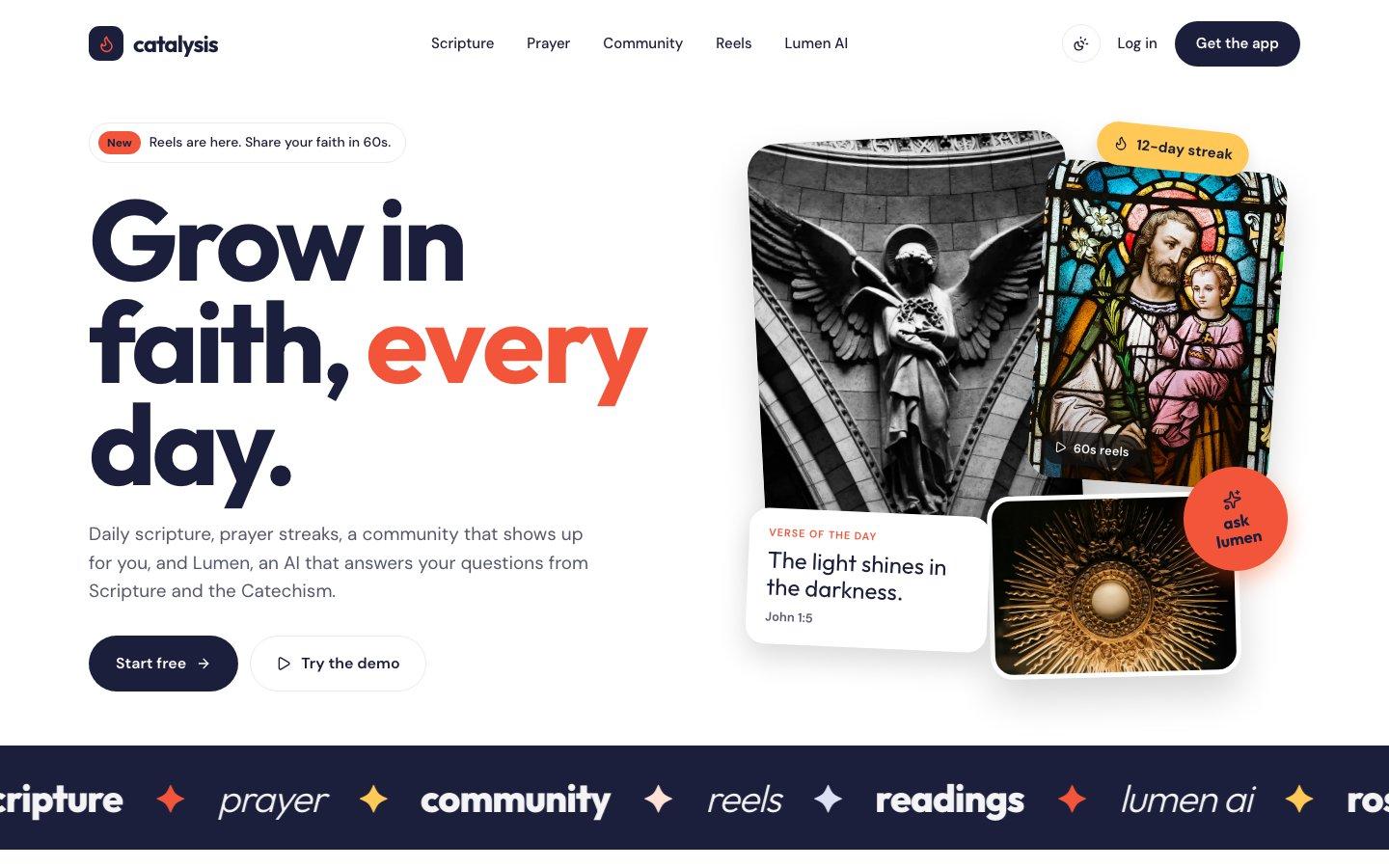
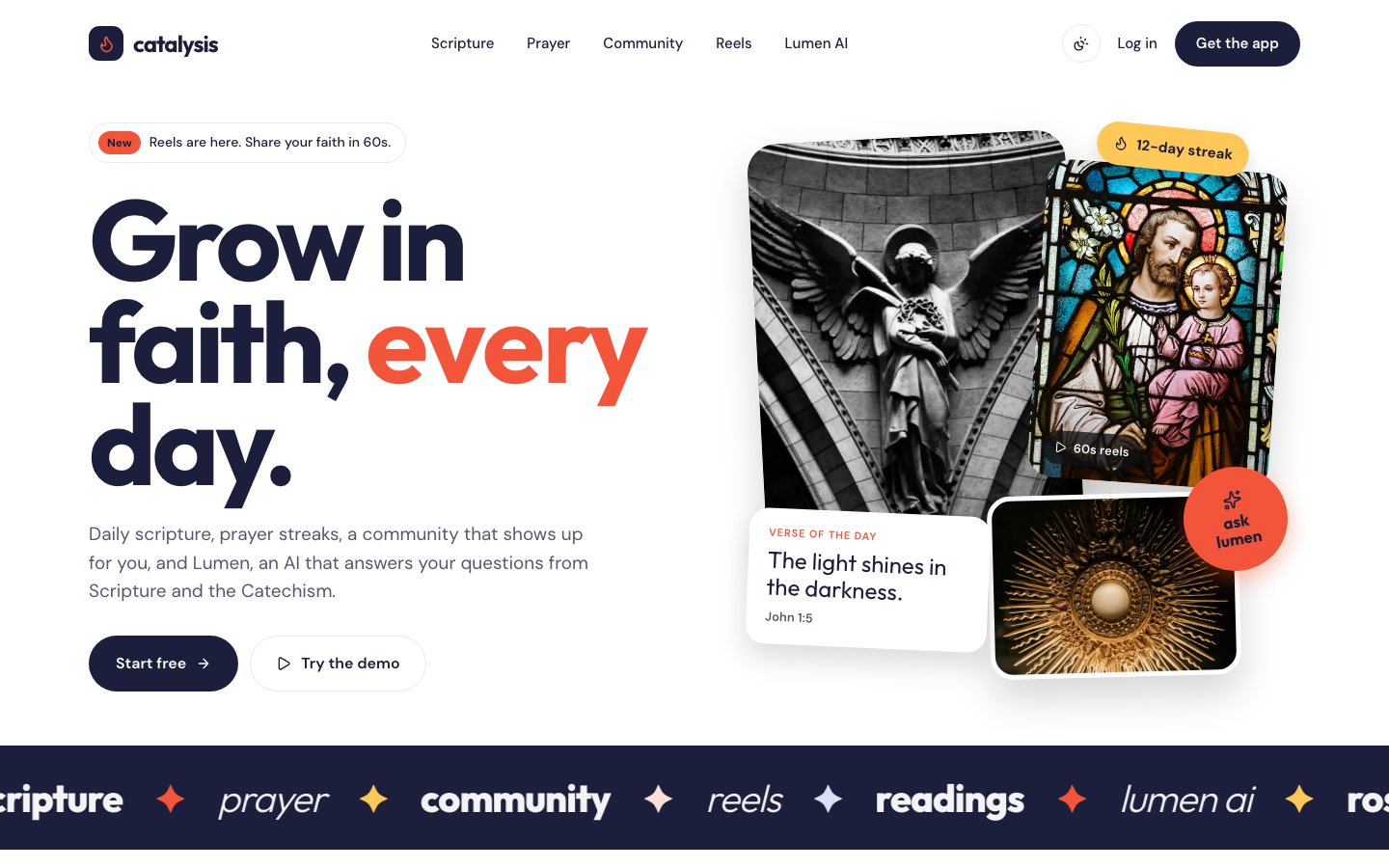
That is the idea behind Catalysis, a Catholic companion app at catalysisfaith.com. Its own tagline says it plainly: Grow in faith, every day. Daily Scripture, prayer streaks, a community that shows up for you, and Lumen, an assistant that answers questions from Scripture and the Catechism and shows you where every answer came from.
Why I built another app
There is no shortage of apps for prayer. Some of them are excellent, and many readers will already have one on their phone. So it's fair to ask why anyone would make another.
My answer comes from watching friends, and myself, in our twenties and in college. Our faith usually doesn't fail because of a dramatic crisis. It thins out. Sunday Mass survives, mostly. The rosary we prayed in high school does not. We have questions about purgatory or the saints or why the Church teaches what she teaches, and we type them into a search bar at midnight and get forty answers from forty people, half of them angry. Meanwhile our phones are extraordinarily good at forming us, hour after hour, in the habits of whoever designed them.
So I made one myself. There was no team and no company behind it, just me, a long list of what I wished my own phone did, and a lot of late nights. I wanted a tool that would form us in different habits. One place that held the day's readings, the day's prayers, the Bible, the Catechism and a community, so that turning toward God didn't require opening six apps and a browser tab. It had to be beautiful, because beauty is not a luxury in the Catholic imagination. And it had to be honest about its limits.
The earliest Christians already had a pattern for this. Luke describes the first community in Jerusalem this way:
They devoted themselves to the teaching of the apostles and to the communal life, to the breaking of the bread and to the prayers.
Acts 2:42
Teaching, communal life, the breaking of the bread and the prayers. An app can do nothing about the third. The Eucharist is given at the altar, not on a screen, and nothing in Catalysis pretends otherwise. But the other three, the teaching, the communal life and the prayers, are the shape of the whole app, and they are the best way to walk through it.
The day begins with the Word
When you open Catalysis, the first screen is called Today. It greets you by name and tells you where you are in the Church's year. As I write this, it reads Friday, November 27, Ordinary Time, Week 34, the last week before Advent.
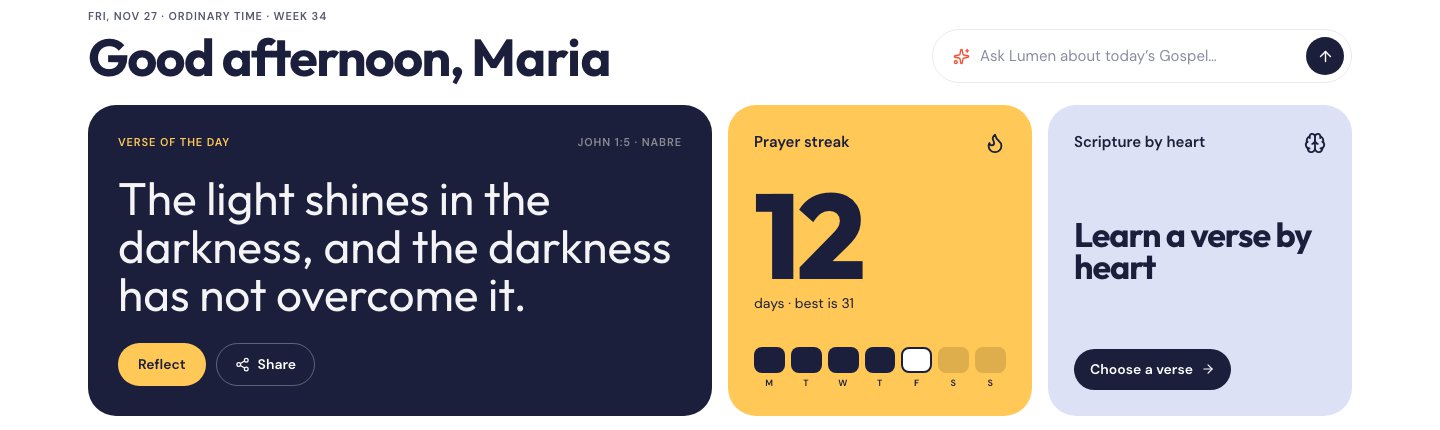
Beneath the greeting sits the verse of the day, in the New American Bible, Revised Edition, the translation proclaimed at Mass in the United States. Today's is from the prologue of John: "The light shines in the darkness, and the darkness has not overcome it." There is a button to share it, and another, which I use more, that simply says Reflect.
From there the day unfolds. The Mass readings are on the same screen, so you can pray with the Gospel before you hear it at church, or after if you missed it. A daily prayers checklist holds the Morning Offering, the Angelus, grace at meals and the evening Examen. On Fridays it adds a gentle reminder of the Friday penance the Church asks of us, the small sacrifice that keeps every Friday a little like Good Friday. A Bible progress tracker shows how much of Scripture you have read. There is even a small window into this magazine, with the newest articles from Mind & Spirit.
Then there is Scripture by heart, which may be my favorite feature. You choose a verse and the app helps you learn it, a few words at a time, until you can say it without looking. We used to do this as children and then stopped, as if memorizing Scripture were something you outgrow. The psalmist did not think so:
In my heart I treasure your promise, that I may not sin against you.
Psalm 119:11
A verse you know by heart goes with you into the places your phone doesn't: the hospital waiting room, the sleepless hour, the exam you didn't study enough for. It's the one feature I most hope people use until they no longer need the app for it.
The teaching, and a light to read by
The second tab is the Bible itself, the complete NABRE, readable from Genesis to Revelation. Any passage can be read aloud with the Listen button. Beside it is the full Catechism of the Catholic Church, searchable, so you can go straight from a question to the paragraph that answers it.
But most of us don't arrive with a paragraph number. We arrive with a question. What does the Church actually say about forgiveness, when it's really hard? Who are the three archangels? How do I pray the Examen? What is purgatory? That is what Lumen is for.
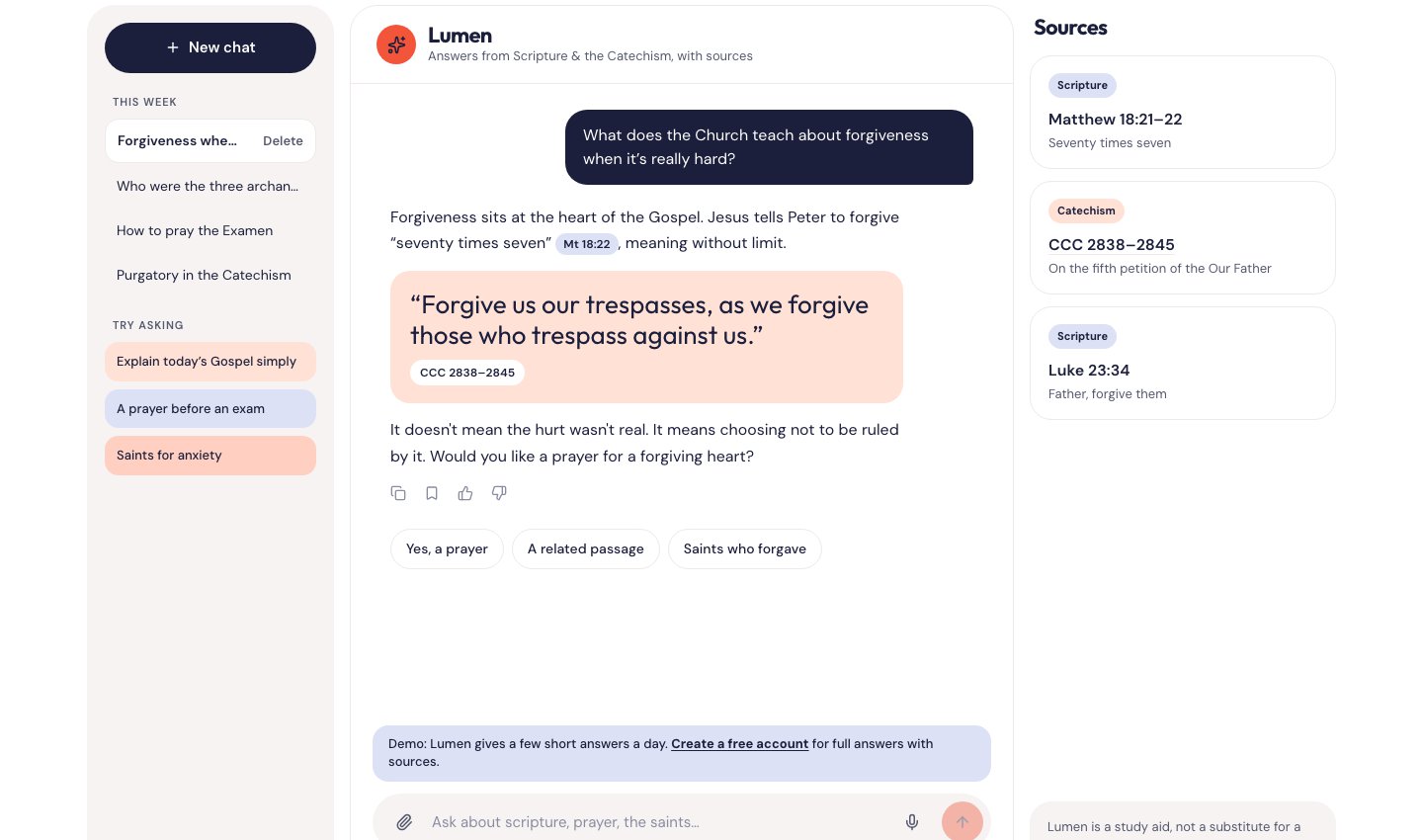
Lumen, from the Latin for light, is an AI assistant, and I want to be careful about how I describe it, because careful is how it was built. Lumen answers from Scripture and the Catechism, and it shows its sources. Ask about forgiveness and it doesn't just paraphrase. It points you to Jesus telling Peter to forgive "seventy times seven" in Matthew 18, to the Catechism's commentary on forgive us our trespasses in paragraphs 2838 to 2845, and to Christ forgiving his executioners from the cross in Luke 23. Each citation sits in a panel beside the answer, so you can open the text and read it yourself. Then, often, it asks whether you'd like a prayer.
Showing the sources matters for a simple reason. An answer you can check is an answer that sends you back to the Church's own words, which is where every answer should end up. Lumen is meant to be a doorway into Scripture and the Catechism, not a replacement for them.
It also says, in plain words at the bottom of every conversation, what it is not:
Lumen is a study aid, not a substitute for a priest or spiritual director.
I mean that sentence. An AI can help you find what the Church teaches about confession. It cannot hear your confession. It can tell you what the Catechism says about grief. It cannot sit with you at a funeral. When a question is really about your own soul, your own sin, your own vocation or your own suffering, the right answer is a person, ordained or wise or both, who knows you and can pray with you. If Lumen ever helps someone work up the courage to make that phone call, it will have done its best work.
The prayers, one day at a time
The Prayer tab is headed with a phrase that is the whole philosophy of the app: Prayer one day at a time.
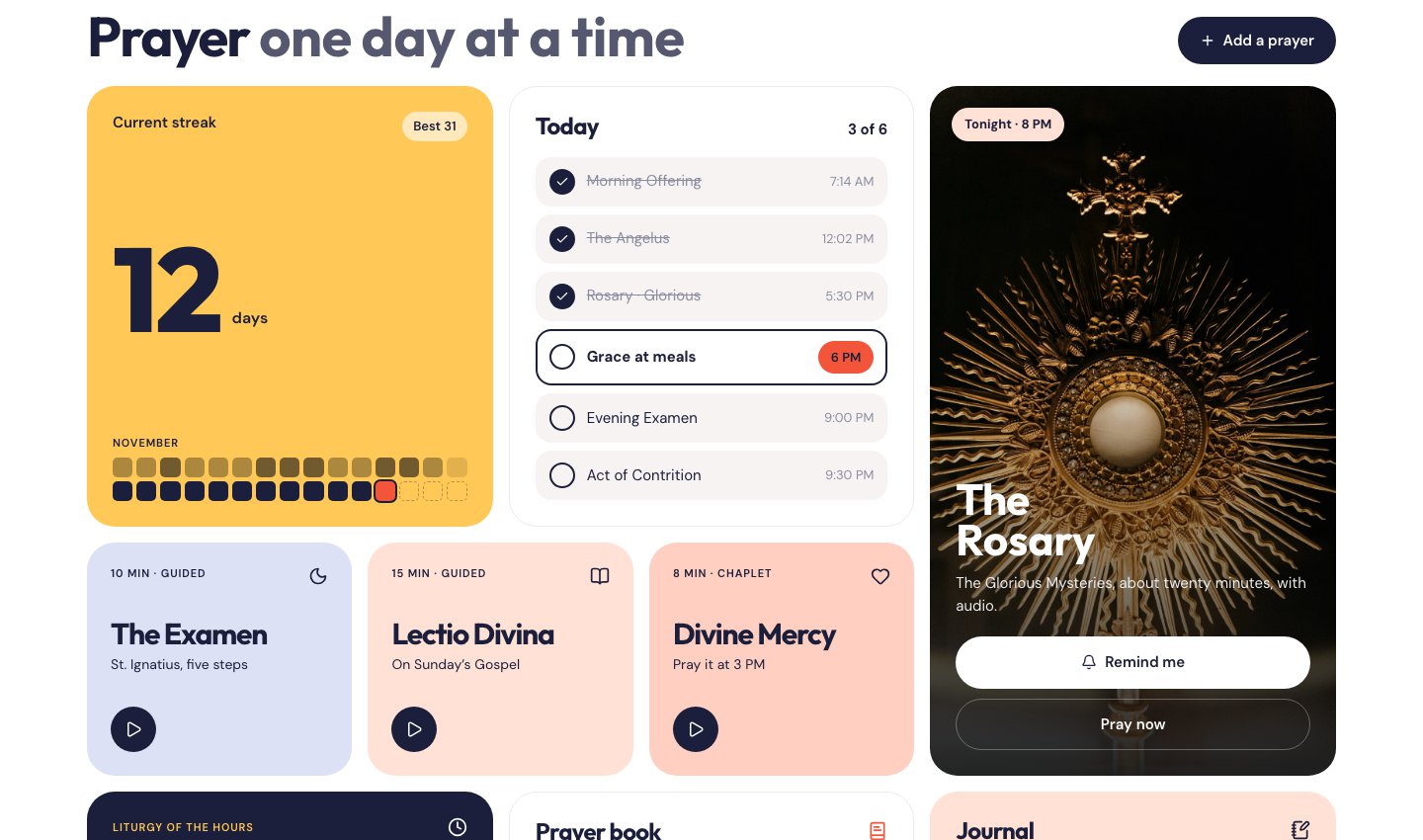
On the left is your streak, the number of days in a row you have prayed, with a little calendar of the month filling in square by square. In the middle is today's checklist, the prayers you've chosen for the day, each with its hour: the Morning Offering at breakfast, the Angelus at noon, a decade of the Rosary on the walk home, the Act of Contrition before sleep. On the right is the evening's Rosary, with the day's mysteries and a reminder you can set.
Below are guided prayers for the times you don't know where to start. There is the Examen of St. Ignatius in five steps, ten minutes at the end of the day to notice where God was and where you turned away. There is Lectio Divina on Sunday's Gospel, the slow, ancient way of reading a passage four times until a single word catches. There is the Divine Mercy Chaplet, eight minutes, best prayed at three in the afternoon. There is the Liturgy of the Hours, the prayer the whole Church prays across every time zone. There is a prayer book of the traditional prayers, from the Memorare to the Prayer to St. Michael. And there is a private journal, for writing down what you heard, or didn't, so you can look back in a year and see the shape of it.
I should say a word about streaks, because I know some readers will be wary. Isn't counting your prayers a little like the Pharisee in the Temple listing his fasts? It could be. Any tool can be turned toward pride. But I've found that the streak does something humbler for most people. It makes faithfulness visible on the days you don't feel anything. The Catechism describes prayer as "the life of the new heart" that "ought to animate us at every moment," and then admits, with real tenderness, that "we tend to forget him who is our life and our all" (CCC 2697). A streak is a small defense against forgetting. And when you break it, as everyone does, you just start again tomorrow. Of all the habits in the spiritual life, starting again may be the most Catholic.
The communal life
The last part of Acts 2:42 is the one I care about most, and the one an app can do least well on its own: the communal life.
Catalysis has a Community tab where you can join groups, a parish young-adult group, a campus ministry, a handful of friends who said they'd pray the Rosary together in Advent. There you can share posts and prayer intentions, so that when someone writes that their mother has a biopsy on Thursday, a dozen people can say I'm praying, and mean it. There are reels, short videos where people share their faith in under a minute: a testimony, a favorite saint, a homily line that wouldn't leave them alone. And there is an Events tab for the things that happen off the screen, the adoration night, the retreat, the service day, Bible study on Wednesday.
That last part is the point. The Letter to the Hebrews names the danger every online community faces:
We must consider how to rouse one another to love and good works. We should not stay away from our assembly, as is the custom of some, but encourage one another, and this all the more as you see the day drawing near.
Hebrews 10:24–25
Rouse one another. The Greek word there is paroxysmos. It is where we get paroxysm, a sudden fit or spasm, and it suggests something stronger than a gentle nudge. It is close kin to what a catalyst does. But notice the warning that follows: do not stay away from the assembly. A Catholic app that kept people at home, scrolling through other people's faith instead of living their own, would have failed, no matter how many minutes a day it held their attention. The measure of the Community tab is not how long people stay in it. It's how many of them show up on Wednesday night because someone in their group posted the time.
Who it's for
Catalysis was made first for young adults and college Catholics. These are the people at the moment in life when faith either becomes their own or quietly slips away. They live on their phones, and they deserve better than what their phones usually give them. But I've been surprised by who else has found it useful: parents who want the readings in front of them before the morning rush, converts working their way through the Catechism, people returning to the Church after years away who don't know where to start and are a little embarrassed to ask.
If you're curious, the simplest thing is to look. The site has a demo you can try without signing up, a sample account with a twelve-day streak and a few conversations with Lumen, where nothing you do is saved or seen by anyone. When you're ready, creating an account is free, and it unlocks your own streak, your own groups and Lumen's full answers with sources. Catalysis runs in the browser today, on a phone or a laptop, and a dedicated mobile app is in the works.
What a catalyst cannot do
I'll end where I began, with the chemistry, because the metaphor has a limit, and the limit is the most important thing about it.
A catalyst doesn't create the reaction. It can't make two substances combine that weren't made to combine. It only makes easier what was already possible, already written into the nature of things.
That's the most any tool can do for a soul. The desire for God is already written into us. "You have made us for yourself, O Lord," wrote St. Augustine, "and our heart is restless until it rests in you." No app put that restlessness there, and no app can satisfy it. What a good tool can do is lower the hill a little. It can put the Word in front of you before the noise begins. It can remind you to pray at noon. It can answer a midnight question with the Church's own words instead of a stranger's. And it can connect you with people who will notice if you don't show up.
Then it should get out of the way, unchanged and unspent, and let the real reaction happen: between you and the God who has been waiting for you all day.
Catalysis was designed and built by Shirley Xu, editor of Mind & Spirit. It is free to try at catalysisfaith.com.