A note before we begin: Studywise is my own work. It's the learning platform of my company, StudyLearners, and I made the whole thing: the idea, the design, the lessons pipeline, the tutor tools, every screen you'll see below. Read this as an introduction from its maker, not an outside review.
Every tutor knows the moment. A student is staring at a problem, pencil still, and you can almost watch the thought hit a wall. Why do I subtract when the signs are different? Why does sodium borohydride leave the ester alone? What is this passage actually arguing? The student isn't lazy and isn't slow. They are stuck at one exact point, and if someone meets them there, the wall comes down. If no one does, it hardens into a belief that sounds like a fact: I'm just not a math person. I'm not good at science.
Anyone who has been on either side of that table knows the same truth: most students aren't failing because the material is beyond them. They're failing in the gaps: the six days between tutoring sessions, the homework done alone at eleven at night, the practice test no one reviewed with them, the parent who wants to help and can't see what's going on.
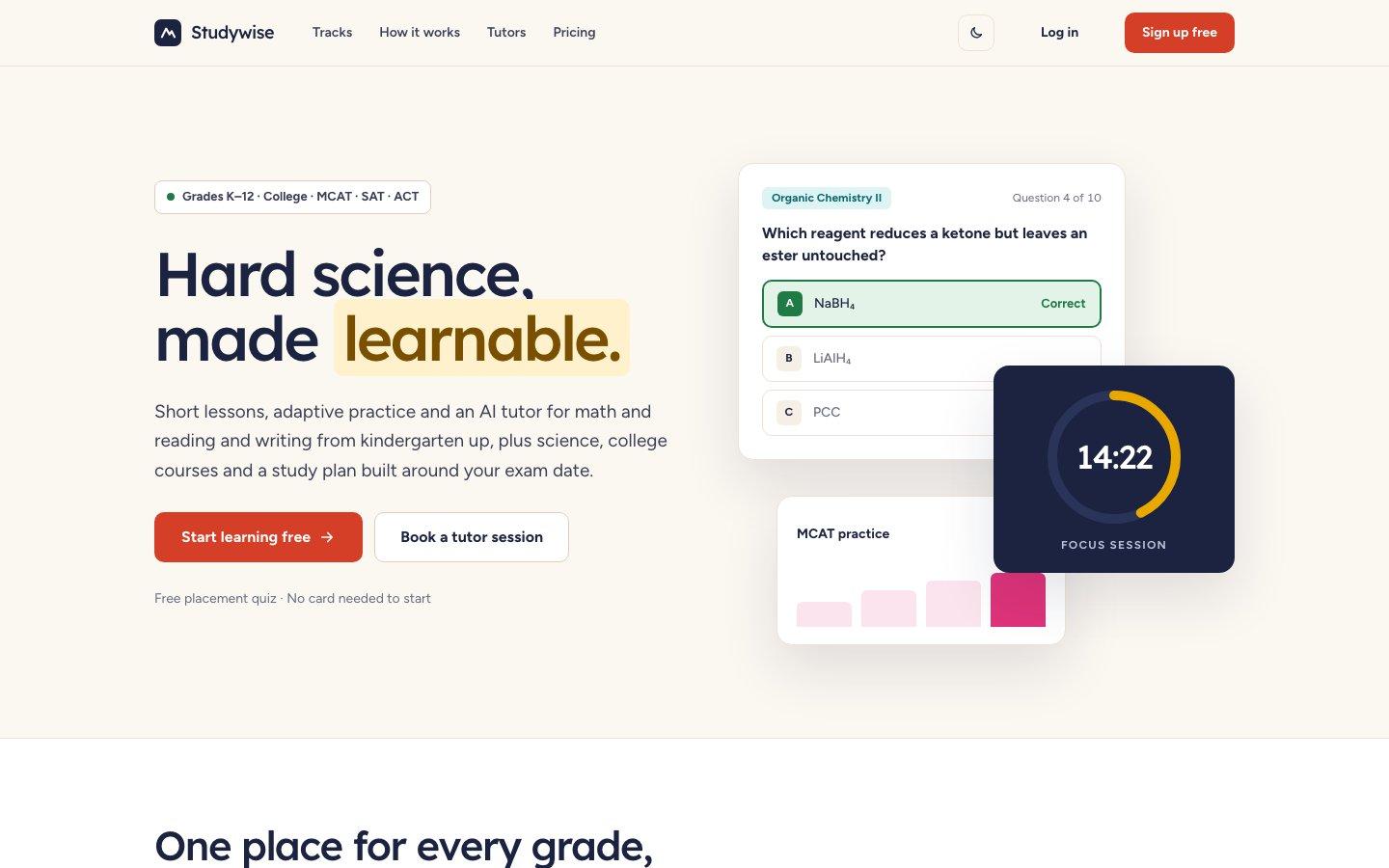
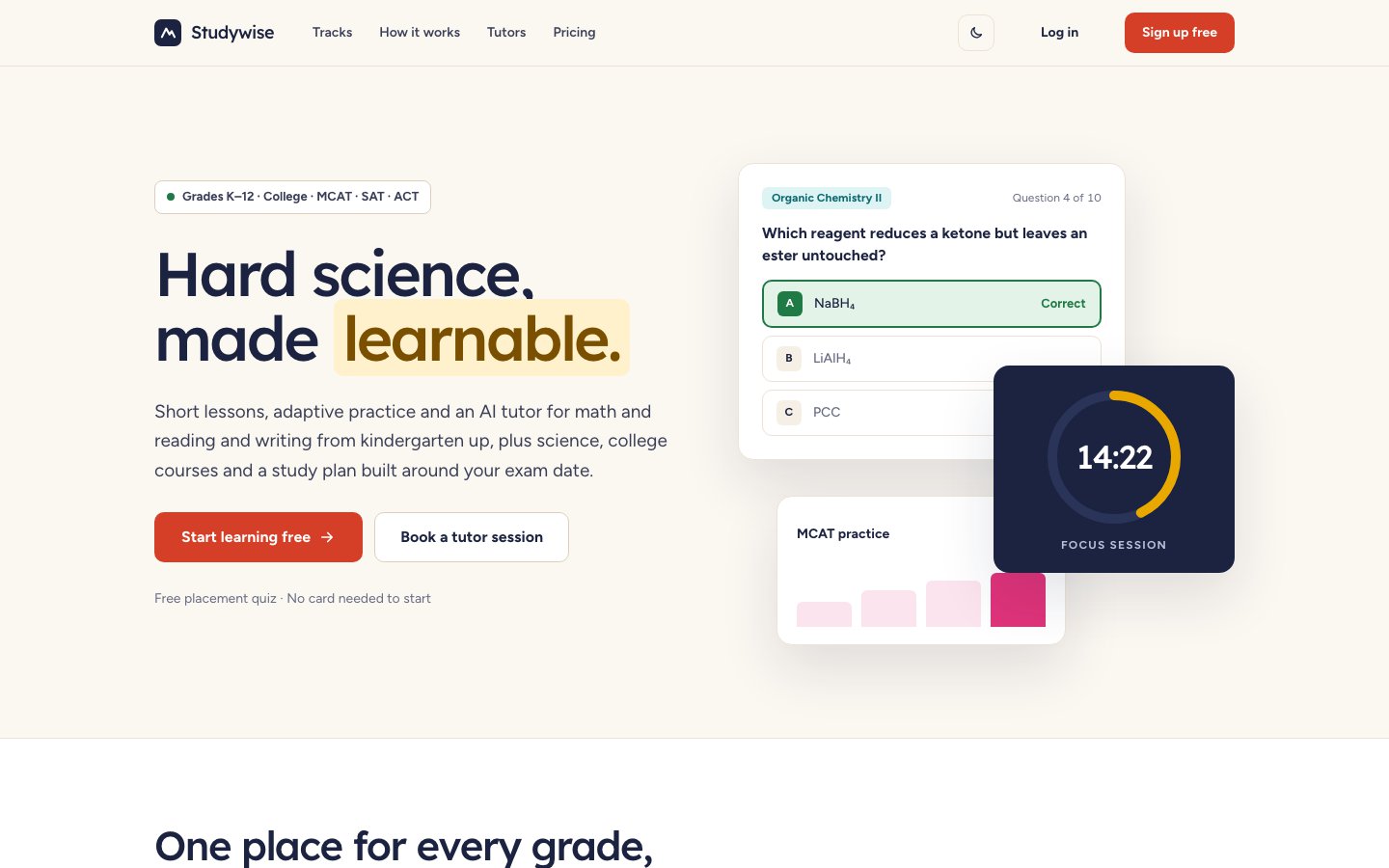
Studywise, at studylearners.com, is my attempt to close those gaps. The tagline on the front page says what it's for: Hard science, made learnable.
One place, kindergarten to the MCAT
Most learning apps pick a lane: early reading, or SAT prep, or college chemistry. Studywise covers the whole road, because students don't stop needing help when they change schools, and families don't want a new app for every grade.
There are four tracks:
- Kindergarten to Grade 8: math and reading and writing at every grade, from number sense and phonics to fractions, ratios, pre-algebra, grammar and essay writing.
- High school: Algebra 1 and 2, Geometry, Precalculus and English 9 to 12, plus biology, chemistry and physics.
- College: the courses that make or break pre-med, including general chemistry, organic chemistry, biology and physics.
- Test prep: the Digital SAT, the ACT and all four sections of the MCAT.
Across the kindergarten-to-twelfth-grade courses alone there are twenty-six courses, more than 850 lessons, about 4,400 practice questions and more than 2,000 vocabulary flashcards. The SAT track has its own full-length practice test that runs like the real one: two Reading and Writing modules, a break, two Math modules, a timer, a question map, flagging, and a score estimate on the 200-to-800 scale when you finish, broken down by skill. The chemistry track is built on Chemistry 2e, the free, openly licensed textbook from OpenStax at Rice University, with hundreds of worked examples and more than a thousand end-of-chapter exercises.
Learn, Practice, Study, Plan
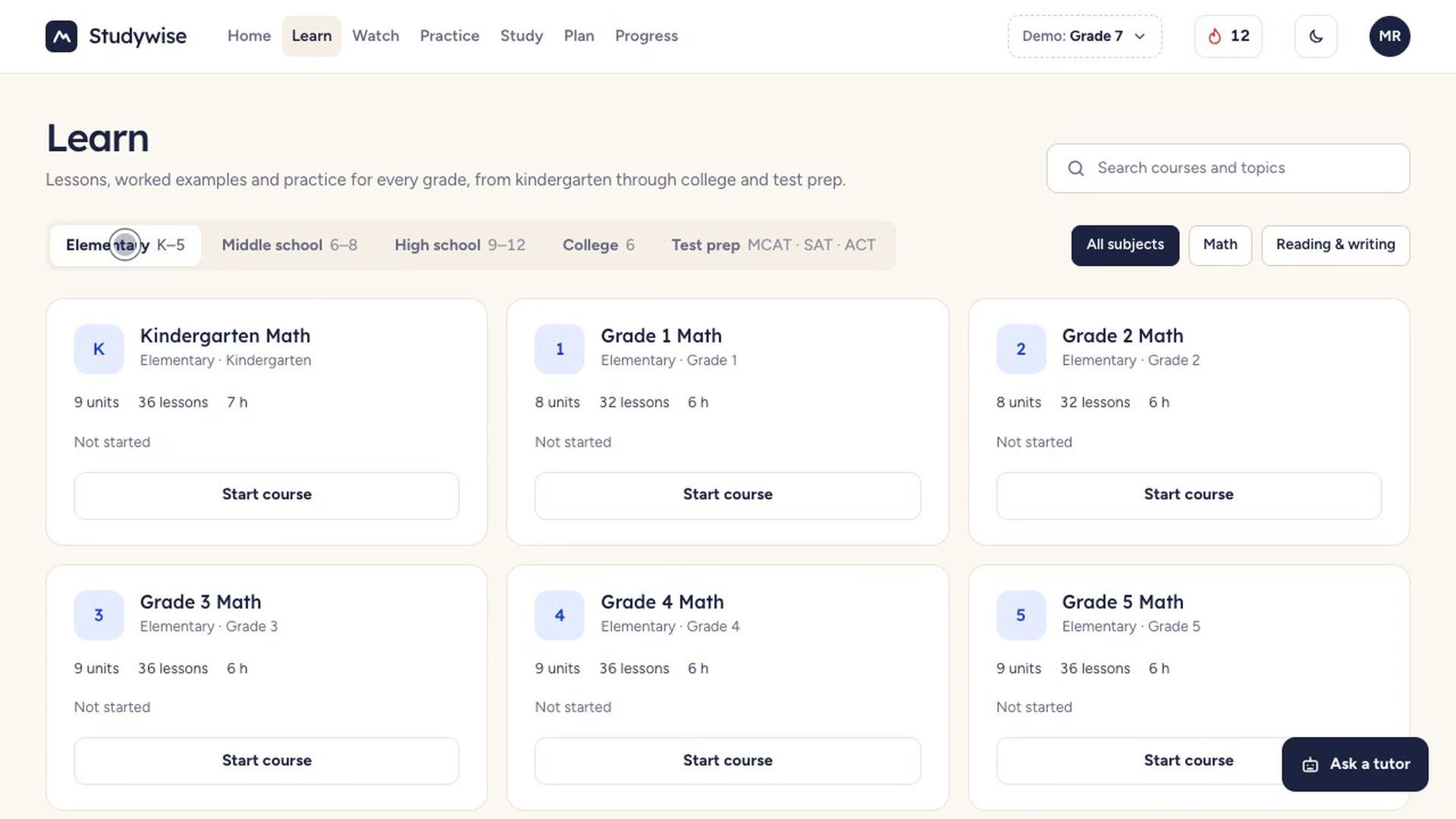
Inside the app, everything is organized around four verbs. They work together, so that every lesson leads to practice and every mistake becomes something you review.
Learn is where new material comes in: short lessons with a single "big idea" at the top, an outline, worked examples you can step through, and vocabulary. Younger students get reading passages with a Listen button that reads them aloud. Writing lessons come with a writing coach that gives feedback on a draft.
Practice is where you find out whether you really understood. There are topic quizzes, unit checkpoints, a searchable question bank and full-length exams. Wrong answers come with explanations, not just a red X. For younger students there's a math-facts speed drill, and its answers are calculated by the program itself, never guessed by an AI, because a seven-year-old should never be marked wrong for a right answer.
Study is where things stick. Flashcards use spaced repetition, the well-tested method of showing you a card again just before you'd forget it, so the hard cards come back often and the easy ones fade into the background. You can build your own deck, and every chemistry lesson has a button to add its key terms to your cards. There's a Pomodoro timer for focus sessions, because half of studying is just sitting still long enough.
Plan pulls it together. Tell Studywise your exam date and it builds a weekly schedule backward from it. You can add your own deadlines, tests, weekly goals and daily tasks.
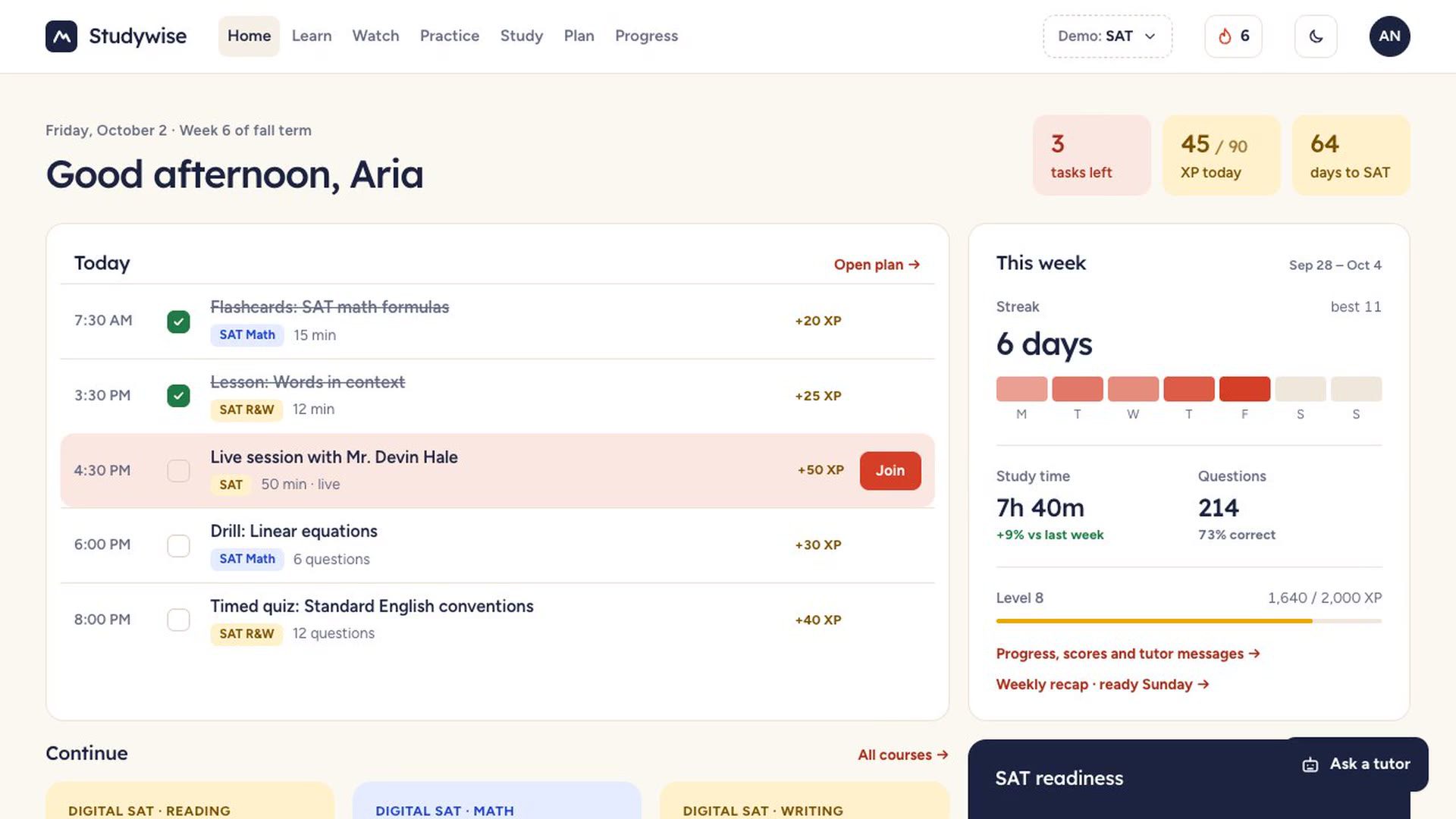
When you open the app, the Home screen shows today's plan in order: a flashcard set at 7:30, a lesson after school, a live tutoring session at 4:30, a drill after dinner, a short timed quiz before bed. Beside it are your streak, your study time for the week and, for test-prep students, a readiness score tracking toward your goal. It's meant to answer the question every student asks when they sit down: what should I do right now?
A tutor at eleven at night
Every page in Studywise has an Ask a tutor button. It opens the AI tutor, which knows which lesson you're on.
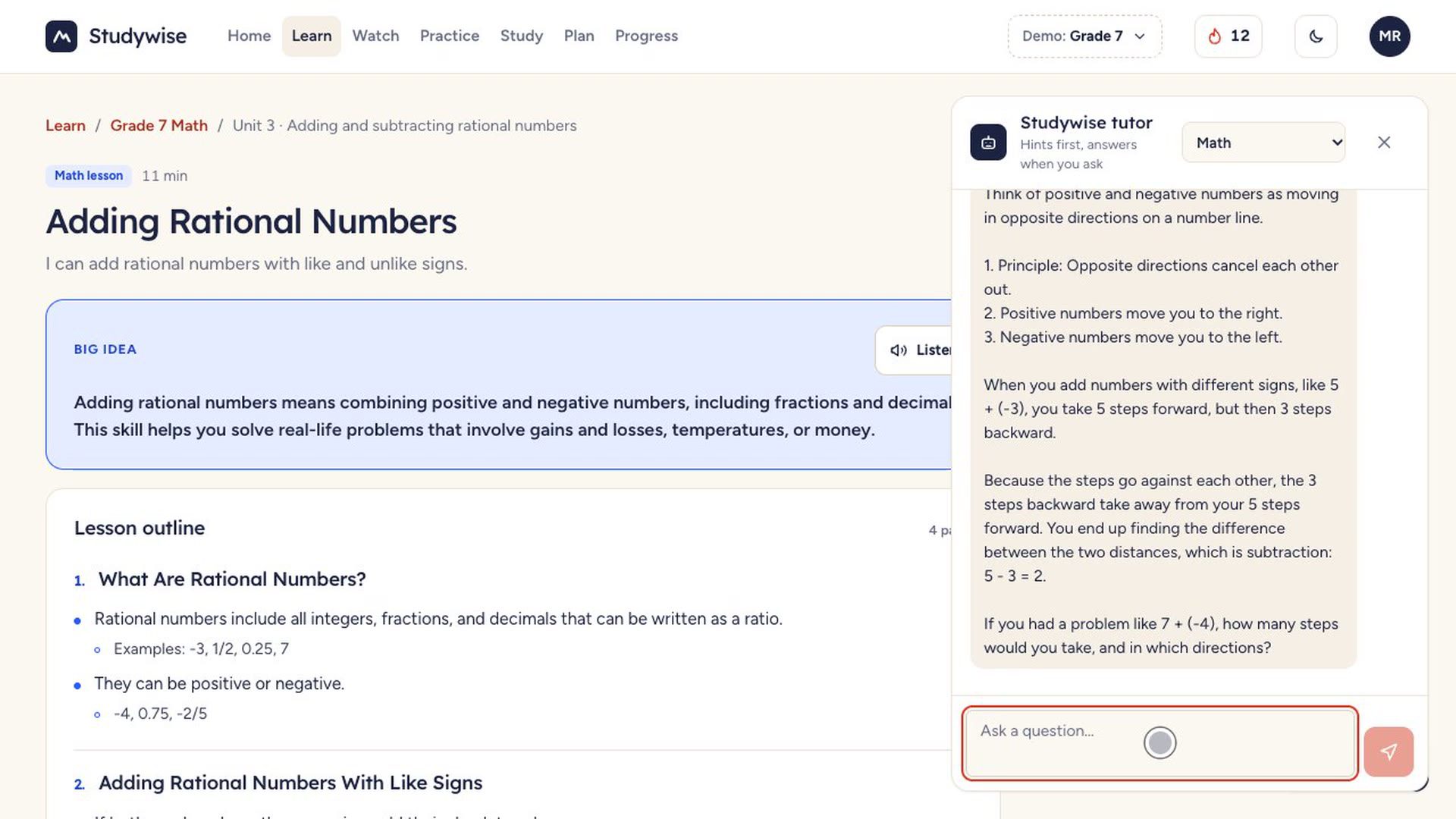
I want to be precise about how the tutor is designed, because AI in education can go very wrong. It doesn't just hand over answers. It gives hints first: a nudge, then a bigger nudge, then a worked step, so the student does the thinking. It adjusts its language to the grade, so a fourth grader and a pre-med student asking about the same idea get very different explanations. It follows stricter safety rules for elementary and middle school students. And it can show its reasoning the way a good teacher would at the board, with equations, diagrams and charts.
There's also a feature students love: on a flashcard, you can ask the tutor to explain it differently, as an analogy, as if you were twelve, or step by step. When an explanation doesn't land, a different one often does.
The AI tutor is not a replacement for a human one. It's for the hours when no human is available, so a student who gets stuck at night can keep going instead of giving up and bringing the same confusion to next week's session.
Built for tutors, too
Here is where Studywise is different from most study apps. It was designed from the start for tutoring centers: the tutors, the families and the directors who run them, not just the students.
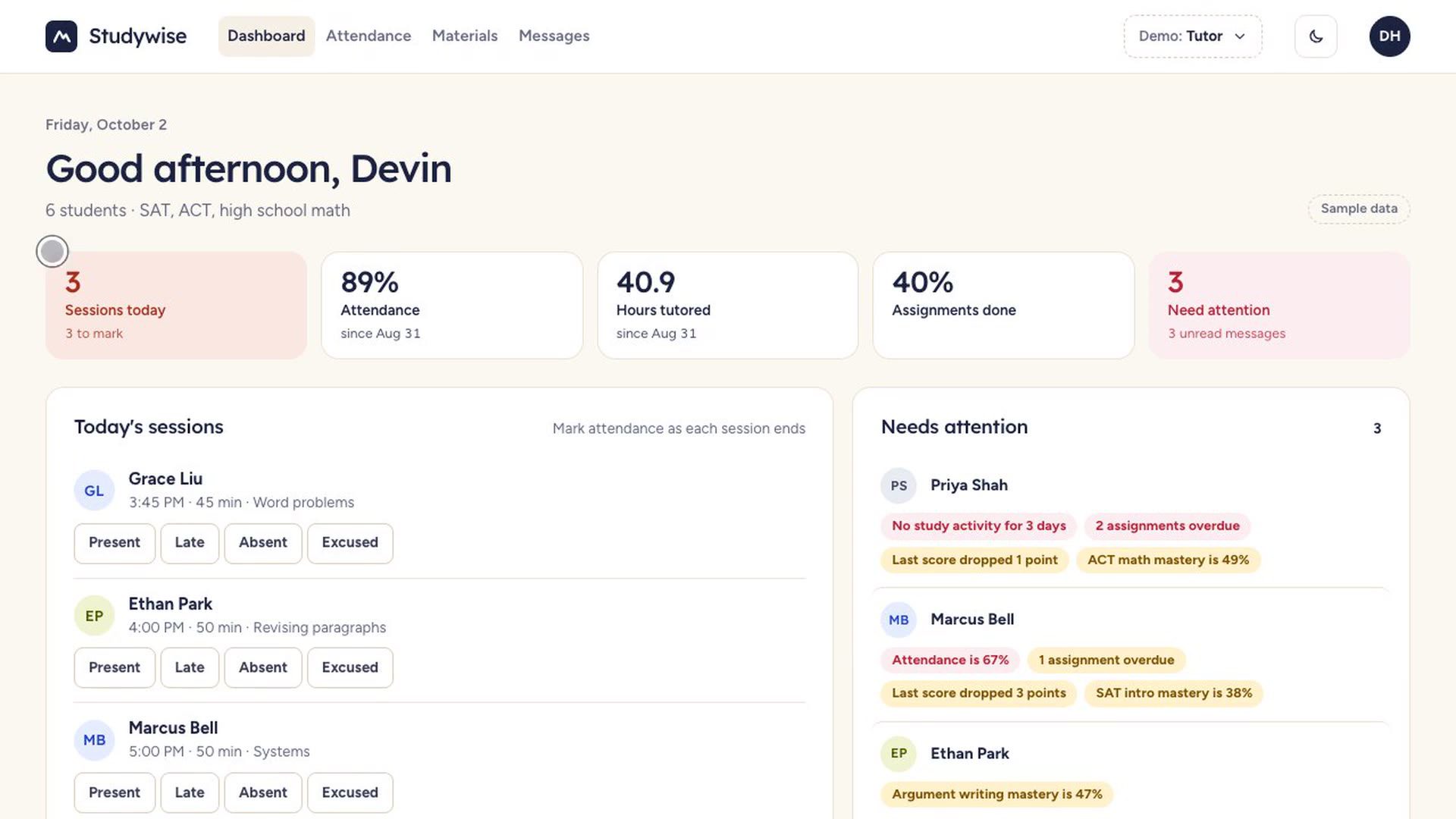
A tutor's day starts on a dashboard of today's sessions. Attendance is one tap per student: present, late, absent or excused. A Needs attention column flags anyone who has gone quiet for three days, fallen behind on assignments or dropped points on a checkpoint, so problems surface before they become crises.
Each student has their own page with homework, classwork and exam results shown as trends against their goal, plus skill-by-skill mastery. That way a session can start with your Algebra 2 factoring is at 38 percent, let's go there instead of so, how's it going? Tutors write session notes, private or shared with the family. They assign work, upload study materials and message students between sessions.
When a student is slipping, a tutor can ask Studywise to draft next week's plan from the student's scores, attendance and activity. The draft is only a draft. The tutor reads it, edits it and decides what to share. I built it that way on purpose. The judgment about a child belongs to the adult who knows that child.
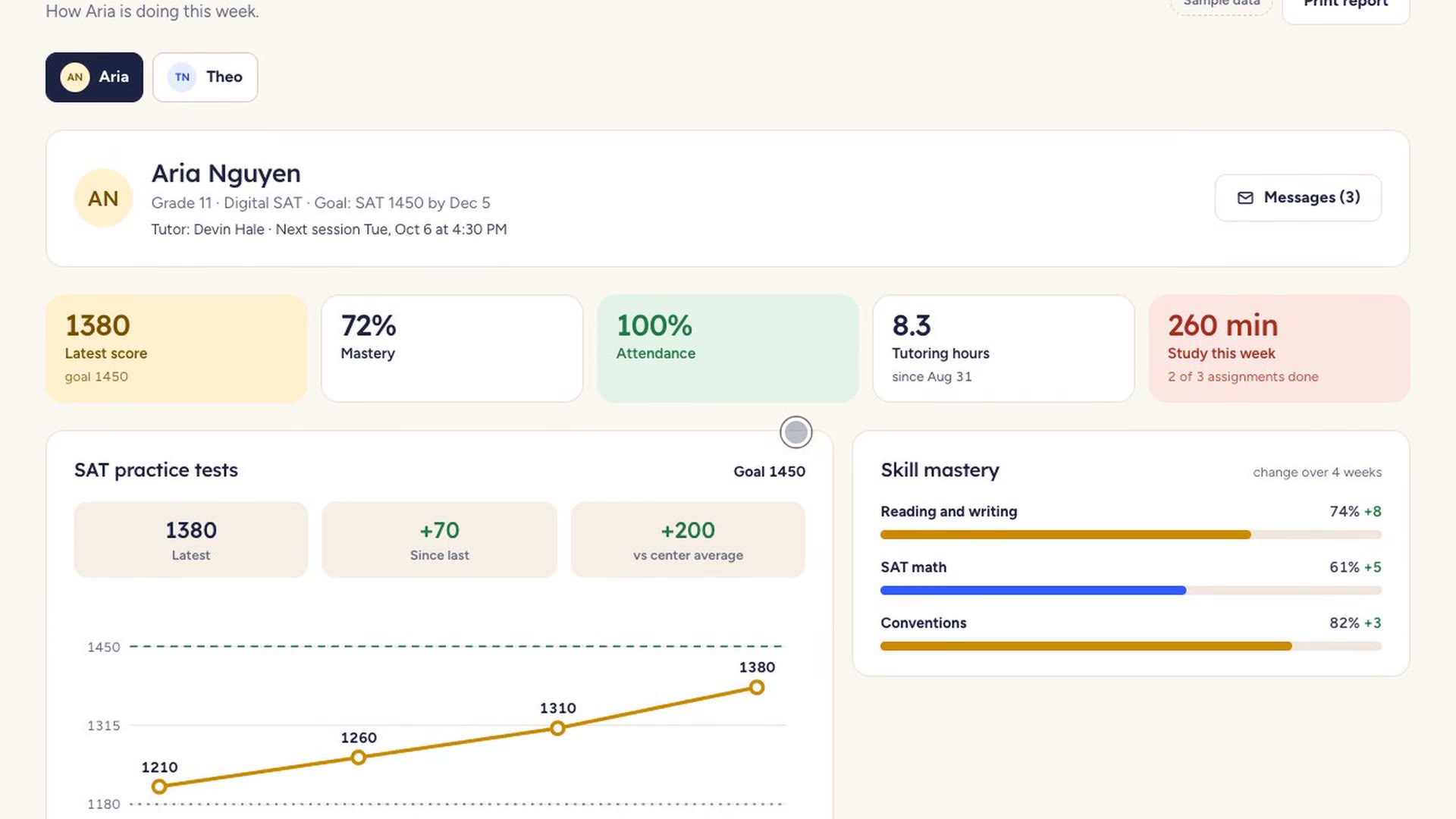
Parents get their own view: progress, attendance, tutoring hours, score trends and the notes the tutor chooses to share. They can message the tutor and print a report for the refrigerator or for the next parent-teacher conference. Families with more than one child can switch between them. Directors see the whole center at once: engagement, attendance, tutor workload and student outcomes, with an export button for the spreadsheet people.
What I'm careful about
A company that teaches children has to be honest about what it hasn't finished yet. So here is what I'd want to know if I were a parent or a tutoring director.
The lesson content is original. None of it is copied from textbooks or published tests. Most of the kindergarten-to-twelfth-grade material was drafted with AI and organized around the Common Core domains. Every practice question was then re-solved by a second, independent check, and any question where the check disagreed with the answer key was thrown out. That removed about four percent of them. That's a real quality gate, but it isn't the same as a teacher's eye, and the lessons are still waiting for review by experienced educators. That review is one of the main things I'm asking partner tutoring centers to help with. The kindergarten and first-grade phonics lessons are text only for now, which makes them the weakest part of the platform. Every screen in this article uses sample students and sample data, not real children.
I'd rather say these things up front than have someone discover them later. Trust is the whole business when you work with other people's kids.
Why a magazine about mind and spirit cares about chemistry
Readers of this magazine might wonder what a study platform is doing between essays on Scripture and the brain. The answer is that I don't think the two are separate.
The Church has always insisted that the mind is a gift worth training. "Faith and reason are like two wings," St. John Paul II wrote at the opening of Fides et Ratio, "on which the human spirit rises to the contemplation of truth." The universities of Europe were founded in the shadow of cathedrals. Many of the people who built modern science, from Copernicus, a canon of the Church, to Gregor Mendel, an Augustinian friar, and Georges Lemaître, the priest who first proposed what we now call the Big Bang, saw the order of the world as something worth understanding precisely because Someone had ordered it.
And there is something deeply human, maybe even holy, in the moment a child finally understands. Proverbs puts it simply:
The beginning of wisdom is: get wisdom; whatever else you get, get understanding.
Proverbs 4:7
Every student who decides I'm just not a math person has believed something false about themselves. They have mistaken a gap in their help for a limit in their mind. I built Studywise for them: to meet them at the exact point where they're stuck, at whatever hour, and to make sure the adults who care about them can see what's happening and help.
Try it
Studywise is live at studylearners.com. Students can start learning free with a placement quiz, and no card is needed to begin. Tutors and parents can sign up for their own views. If you run a tutoring center, or teach, and would like to see how it fits your curriculum and your students, I'd love to hear from you. I'd especially love to hear what you think is missing.
The hardest subjects aren't the ones beyond a student's reach. They're the ones where no one met the student at the point where they got stuck. I'd like to change that.
Studywise was designed and built by Shirley Xu, editor of Mind & Spirit and founder of StudyLearners. Chemistry content is adapted from Chemistry 2e by OpenStax, licensed under CC BY-NC-SA 4.0; access for free at openstax.org.